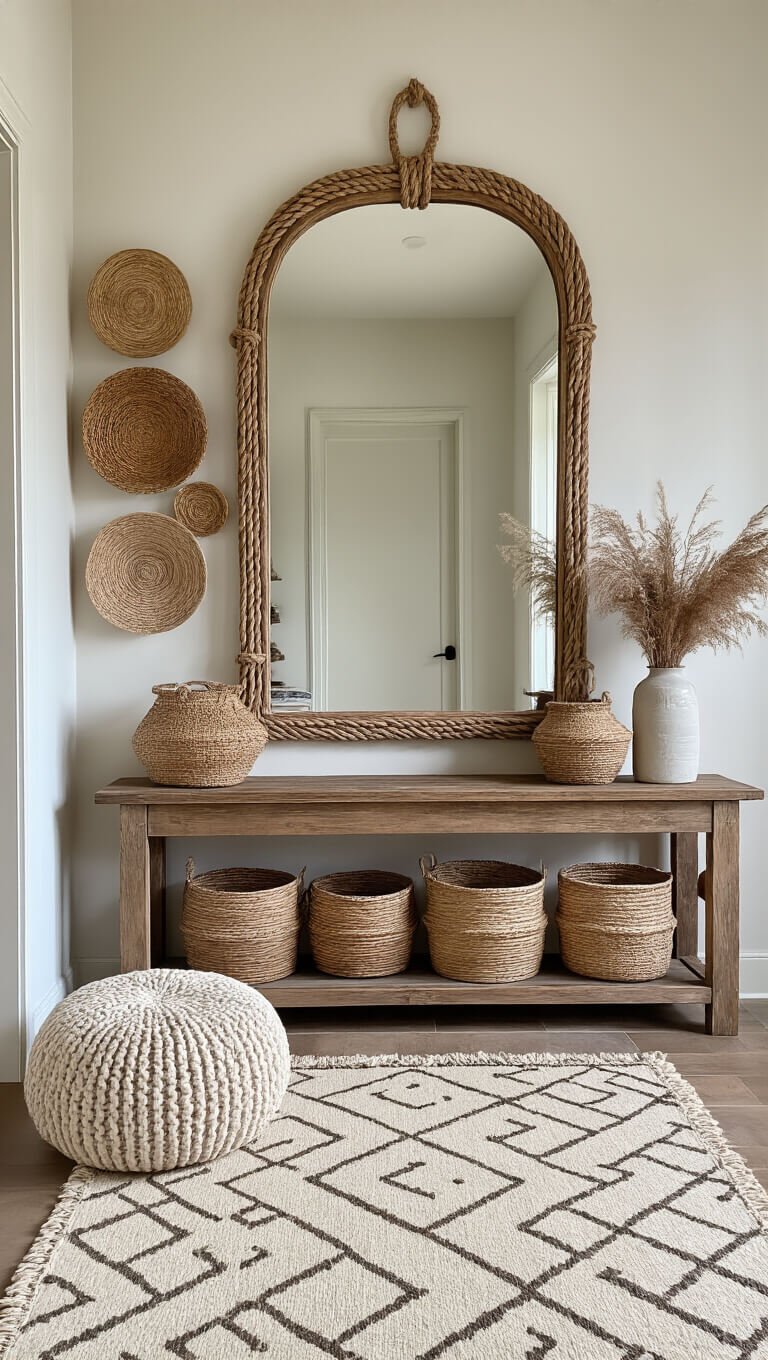
Here’s my entryway situation: my front door opens directly into my living room. No foyer, no hallway, no charming little mudroom — just a door, and then you’re standing where we watch TV. For years, shoes piled up in a sad drift by the door, keys vanished into the couch cushions, and every guest got the same apologetic “sorry about the mess” as they stepped over a pair of sneakers.
🍂 Entryway done? Now the main event — 25 cozy fall living room decor ideas with photos for every idea.
Then I learned the secret that changed everything: you don’t need square footage to have an entryway. You need a zone. A rug that says “this is the entry,” hooks that catch the coats, a mirror that bounces the light, one surface for keys, one basket for the chaos. Five elements, about a hundred dollars, one Saturday afternoon — and suddenly my door opens into a home that feels intentional instead of accidental.
These ideas work whether you have a grand foyer or, like me, basically no foyer at all. They’re renter-friendly, budget-honest, and tested in a real home where real people lose their keys daily. Pin this to your Small Spaces board — your future self, arriving home with arms full of groceries, says thank you.
1. Define the Zone With a Rug
Even a 2×3-foot rug by the door visually declares “this is the entryway.” It creates a boundary your brain respects — shoes stay on the rug, the living room stays beyond it.
Why it works: Without a rug, there’s no line between “outside mess” and “inside clean,” so the mess spreads. A rug draws that line for you. It also catches the dirt, which is doing your floors a real favor.
Budget move: A washable low-pile runner or 2×3 rug runs $20–$35. Washable is non-negotiable here — entryways take a beating, and a rug you can’t throw in the wash becomes a regret within months. Styling tip: A runner works even better than a square rug if your door opens into a hallway or along a wall — it leads the eye inward and makes the “zone” feel longer.
2. Add One Slim Surface
You need exactly one surface: somewhere to drop keys, mail, and sunglasses the second you walk in. A console table just 10–12 inches deep, a narrow bench, or even a wall-mounted shelf fits almost anywhere.
Why it works: Without a designated drop spot, keys and mail migrate to whatever flat surface is nearest — usually the couch or the kitchen counter, where they become clutter. One small surface near the door contains the daily inflow.
Budget move: A slim console table runs $50–$80; a wall-mounted shelf with brackets is $20–$30 and takes zero floor space. Thrift stores are full of narrow tables nobody else wants — perfect for you. Styling tip: Put a small tray or bowl on the surface specifically for keys. A designated key spot ends the “where are my keys” panic forever. (Mostly. We’re all human.)
3. Hang a Mirror — It’s Non-Negotiable
A mirror by the door does triple duty: it bounces light into what is often the darkest corner of the house, it makes the space feel twice as big, and it gives you that last-second check before you head out.
Why it works: Entryways are usually small and often windowless. A mirror is the cheapest way to fake both light and space — it literally doubles whatever light and square footage you have.
Budget move: A round mirror runs $25–$40; arch mirrors are trending and run $30–$50. Styling tip: Round or arched mirrors soften all the hard corners of an entryway. Hang it at eye level — and angle it to reflect a window or a pretty view, not the inside of your closet.
4. Choose Hooks Over a Coat Closet
A row of 3–5 sturdy wall hooks holds coats, bags, dog leashes, and tomorrow’s jacket better than any overstuffed closet. Hooks are faster than hangers, which means people actually use them.
Why it works: Let’s be honest: nobody in a busy household carefully hangs coats on hangers in a closet. Hooks match real behavior — grab, hang, go. A coat on a hook is a coat put away; a coat draped over a chair is clutter.
Budget move: A good 5-hook rail runs about $15–$25. Mount it into studs if you can — a rail full of winter coats is heavier than it looks. Styling tip: Assign hooks: one per person, plus one for guests. Labeled hooks (even just with a little tag) end the “whose coat is on my hook” wars.
5. Contain the Shoe Chaos in One Basket
Shoes, umbrellas, reusable grocery bags, the dog’s spare leash — one large woven basket by the door swallows it all and looks good doing it.
Why it works: The basket is permission to be imperfect. Shoes don’t need to be lined up like a store display; they just need to be in the basket instead of across the floor. Contained mess reads as “lived-in”; scattered mess reads as “chaotic.”
Budget move: A large woven basket runs $20–$30. Styling tip: One basket per adult for shoes, max. If the basket overflows, that’s your signal to put pairs away — the basket is a buffer, not permanent storage.
6. Welcome Guests With a Wreath
A wreath on the front door is the first thing visitors see, and it sets the tone before they even knock. Swap it seasonally — or make one base and re-dress it through the year.
Why it works: A wreath signals care. It’s a small thing, but a door with a wreath feels like a home where someone’s happy to see you. A bare door feels like nobody’s home.
Budget move: Our DIY wreath guide shows you how to build one grapevine base and re-dress it for every season — about $15 in materials for a wreath you’ll use all year. Styling tip: Size the wreath to the door: a standard 36-inch door wants an 18–24 inch wreath. Too small looks apologetic; too big overwhelms.
7. Add a Bench Cushion (and Make It Pretty)
If you have a bench in your entryway, a cushion makes it a place people actually sit to put on shoes — and it’s a perfect spot for a pop of pattern or seasonal color.
Why it works: An uncushioned bench is a surface; a cushioned bench is an invitation. It also softens the hardest-working furniture in the entryway and gives you an easy seasonal swap.
Budget move: Instead of buying new cushions every season, make your own covers — our no-sew pillow cover tutorial works for bench cushions too, for under $5 in fabric. Styling tip: Use outdoor or washable fabric for bench cushions. Entryway cushions meet muddy jeans and wet dogs — plan accordingly.
8. Light It Like You Mean It
Entryways are often the darkest spot in the house, but they’re the first thing you see coming home. A small lamp on the console, a plug-in wall sconce, or even a battery-operated picture light makes it feel welcoming instead of cave-like.
Why it works: Walking into a dark entryway after a long day feels deflating; walking into a warmly lit one feels like the house is glad you’re home. Light is mood, especially in small spaces.
Budget move: A small table lamp is $20–$30; a plug-in sconce runs $25–$40 with no wiring needed. Battery-operated LED picture lights ($12–$18) are a renter’s best friend. Styling tip: Put the entryway light on a timer or smart plug set to dusk. Coming home to a lit entryway every single evening is a small daily joy.
The 5-Minute Entryway Formula
If you do nothing else, do this: rug + hooks + mirror + one surface + one basket. Five elements, under $100 total if you shop smart, one afternoon to set up. That’s a complete entryway — defined, functional, and welcoming — whether you have a foyer or just a door that opens into the living room like mine.
Shop Smart: What This Actually Costs
The honest price map for a full small-entryway setup:
Under $25: 5-hook rail ($15–$25), washable 2×3 rug ($20–$35), key tray or bowl ($8–$12), DIY wreath materials ($15)
$25–$50: round mirror ($25–$40), large woven basket ($20–$30), small lamp ($20–$30), bench cushion covers (DIY, under $5)
$50+: slim console table ($50–$80), narrow bench ($50–$80)
The 5-element formula (rug, hooks, mirror, surface, basket) lands around $100–$130 total — and honestly, the hooks and the key tray alone will change your daily life the most. Start there if budget is tight.
Common Mistakes to Avoid
1. Buying furniture before defining the zone. A console table floating in an undefined space just looks like random furniture. Lay the rug first — the zone comes first, the furniture fills it.
2. Choosing a non-washable rug. I cannot stress this enough. Entryway rugs meet mud, rain, snow, and dog paws. If it can’t go in the washing machine, it will be a stained regret by spring.
3. Mounting hooks with adhesive strips under heavy loads. Adhesive hooks are fine for one light jacket. A rail full of winter coats needs screws into studs. A hook rail crashing down at 2 a.m. is a special kind of heartbreak.
4. Letting the entryway become a second closet. The entryway handles daily in-and-out: today’s coat, today’s shoes, today’s bag. Off-season coats and the shoes you wear twice a year belong in a real closet. When the entryway starts storing everything, it stops working for anything.
Frequently Asked Questions
How do I make an entryway when my door opens straight into the living room?
Define a zone: lay a rug by the door, add hooks on the nearest wall, and place one slim surface for keys. The rug is the key move — it creates a visual boundary that tells everyone (including you) “entryway starts here, living room starts there.”
What’s the minimum an entryway actually needs?
Five things: something for shoes (rug or basket), something for coats (hooks), something for keys (tray or bowl on a surface), a mirror, and light. Everything beyond that is bonus.
How do I keep a small entryway from looking cluttered?
Contain, don’t display. Baskets with lids, a tray for small items, hooks instead of piles. And enforce the one-in-one-out rule: when a new pair of shoes enters the entryway basket, an old pair goes to the closet.
What’s the best rug for an entryway with pets?
Washable, low-pile, dark or patterned (hides dirt between washes). Avoid shag, jute (holds pet hair and odors), and anything with a rubber backing that crumbles in the wash — look for rugs specifically labeled machine-washable.
Can I have a nice entryway in a rental?
Absolutely — this is one of the most renter-friendly projects there is. Freestanding rug, basket, and bench need no installation. Use removable adhesive hooks (light loads only) or a freestanding coat rack, lean the mirror instead of hanging it, and use a plug-in or battery light. Take it all with you when you move.
Save this to your Small Spaces board on Pinterest — and next time you walk in the door, notice how it feels to have a place for everything. That’s the whole point.