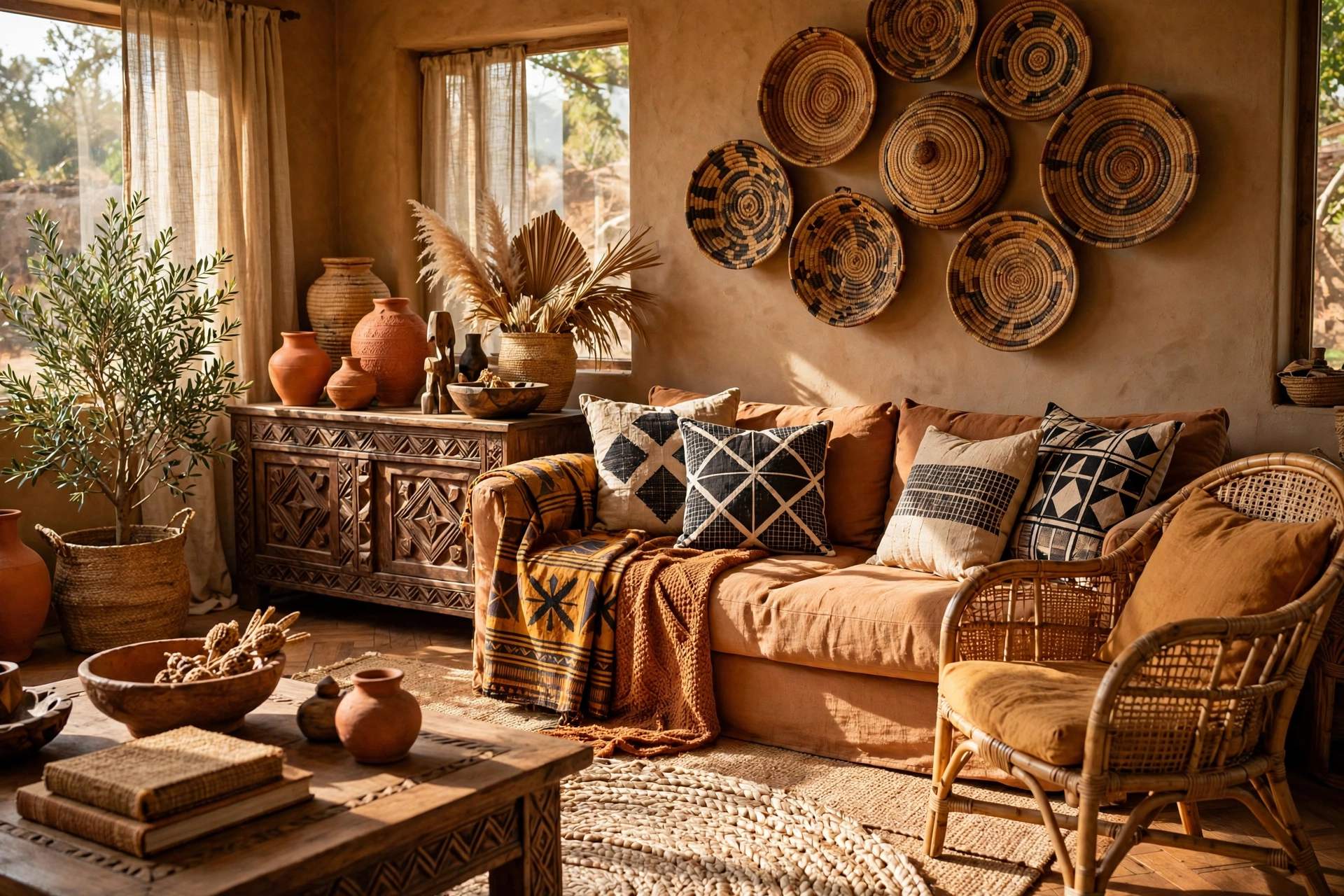
There is a style quietly taking over the prettiest homes on Pinterest in 2026, and it is warm, soulful, and deeply textured. Afrohemian decor blends African craft traditions with the free, layered feeling of bohemian style: handwoven baskets on the wall, mudcloth cushions on the sofa, rattan glowing in the lamplight, and a palette of sun-baked neutrals, burnt umber, saffron, and warm indigo.
The beauty of Afrohemian texture decor is that it is built from real craft, not matching sets: Nigerian textiles, Malian mudcloth, handwoven seagrass baskets, carved wood, and natural fiber rugs each carry the hand of the maker. This guide shows you how to bring that warmth home with four projects, choosing pieces with care.
What Afrohemian Style Really Means
Afrohemian is a fusion, not a costume. At its heart is African artistry — the bold geometry of mudcloth, the woven patterns of Nigerian aso oke and kente-inspired cloth, the sculptural shapes of handwoven baskets — layered with bohemian softness: rattan, fringe, natural fibers, and plants. The palette stays earthy and warm: clay, sand, terracotta, deep brown, saffron gold, and touches of indigo as an accent.
The key is respect: choose pieces made by artisans whenever you can, learn the name of the craft and where it comes from, and let a few meaningful pieces shine rather than filling a room with imitations. A single handwoven basket or a genuine mudcloth cushion tells a richer story than a shelf of lookalikes.
Materials You Will Need
- Handwoven baskets in a few sizes and shapes, flat and shallow for the wall
- Mudcloth fabric or ready-made mudcloth pillow covers in black and white or earthy tones
- Natural fiber rugs in jute, sisal, or seagrass, in two sizes for layering
- A rattan pendant light shade or a rattan basket to repurpose as a shade
- Carved wooden bowls, a wooden stool, or a small carved figure
- Plain pillow inserts, a needle and thread, and scissors
- Removable adhesive hooks and picture-hanging strips for the basket wall
- A tape measure, a pencil, and a sturdy step stool
- Terracotta pots and a few leafy plants
Project 1: A Woven Basket Wall
1. Collect baskets with different shapes and weaves
Gather five to seven handwoven baskets in different sizes, depths, and patterns, mixing flat discs with deeper bowls and varying the weave — tight coils, open weaves, and bold geometric patterns all look wonderful together. Choosing baskets made by artisans is part of the pleasure of this project.
2. Plan the arrangement on the floor first
Lay the baskets on the floor in a loose cluster, with the largest basket slightly off-center and the smaller ones flowing around it. Leave a few inches between pieces so the wall color shows through, and take a photo so you can recreate the arrangement on the wall.
3. Hang the baskets with removable hooks
Transfer the arrangement to the wall above a sofa, a bed, or a console table, using removable adhesive hooks rated for each basket’s weight. Start with the largest basket, then work outward, checking with a level as you go — a basket wall should look organic, like it grew there.
Project 2: Mudcloth Pillow Covers
1. Choose your mudcloth fabric
Mudcloth, traditionally made in Mali, is cotton cloth patterned with fermented mud in bold geometric designs. Look for authentic fabric or ready-made covers in black and white or earthy, sun-baked tones — two or three cushions are enough to anchor a whole sofa.
2. Sew simple envelope covers
Cut the fabric to fit your pillow inserts, adding an inch for seams, and sew simple envelope-style covers. If sewing is not your thing, ready-made mudcloth covers are widely available and just as beautiful — slip the inserts in and fluff the corners so the pattern sits square.
3. Style the cushions in layers
Place the mudcloth cushions at the ends of the sofa, then layer softer textures in front: a linen cushion in warm sand and a small fringed throw pillow in saffron. The contrast between the bold mudcloth geometry and the soft linen is what makes the arrangement feel rich rather than busy.
Project 3: Layered Natural-Fiber Rugs
1. Start with a large jute base
Lay a large jute or sisal rug as the base layer, covering most of the floor — its rough, golden texture is the foundation of the Afrohemian look. Use a rug pad underneath so it stays put on hard floors.
2. Layer a patterned rug on top
Layer a smaller rug on top at a slight angle: a flat-weave rug with a geometric or striped pattern in warm indigo, umber, and cream works beautifully against the jute, giving the eye somewhere to land.
3. Anchor with furniture and texture
Let the front legs of the sofa or an armchair rest on the layered rugs to hold them in place, then add a carved wooden stool and a terracotta pot with a leafy plant nearby.
Project 4: Rattan Pendant Light Styling
1. Choose a rattan shade with an open weave
A rattan pendant shade with an open, airy weave casts a beautiful pattern of light and shadow across the room. Choose one sized for your space — a large shade over a dining table, a smaller one over a reading chair — and check it is rated for the bulb you plan to use.
2. Hang it over a dining table or reading corner
Hang the pendant from a ceiling hook or an existing light fitting, at a height where it lights the table without blocking the view across it. If you are renting, a plug-in pendant with a long cord and a ceiling hook works just as well, with no wiring needed.
3. Style the space underneath it
Style the table beneath the pendant to match its warmth: a carved wooden bowl, a stack of books, a woven placemat, and a small vase of dried grasses. When the light comes on in the evening, the rattan glows and the whole corner feels like golden hour.
Sourcing With Care
Buy from makers and fair-trade shops when you can, and learn the story behind each piece: a basket woven by hand in a particular region, mudcloth dyed with fermented mud, a stool shaped by a named artisan. If a piece is described as handmade, ask where it was made and by whom, and avoid mass-produced copies that borrow a pattern without supporting the community that created it.
Safety Notes
Check the weight rating on every adhesive hook before hanging a basket, and never hang a basket above a bed or a crib. Use a sturdy step stool for anything above shoulder height, and never stand on a chair or a stack of books. Keep the rattan shade clear of the bulb, use only bulbs rated for the fitting, and keep candles away from natural fiber rugs, dried grasses, and woven baskets.
Frequently Asked Questions
What is Afrohemian decor?
Afrohemian decor is a fusion of African craft traditions and bohemian style: African textiles like mudcloth and Nigerian woven cloth, handwoven baskets, and carved wood, paired with bohemian textures such as rattan, jute, and natural fibers, all in a warm, earthy palette. It is one of the standout home trends Pinterest highlighted for 2026.
How do I start with Afrohemian style on a budget?
Start with the pieces that make the biggest impact for the least money: two or three mudcloth pillow covers, a single large handwoven basket on the wall, and a jute rug. Thrift stores and fair-trade shops often carry baskets and textiles at gentle prices.
Where can I find authentic mudcloth and handwoven baskets?
Look for fair-trade shops, artisan markets, and makers who can tell you where a piece was made and who made it. Genuine mudcloth is cotton cloth patterned with fermented mud, traditionally made in Mali, and authentic baskets are handwoven, with small variations that show the maker’s hand.
What colors work best in an Afrohemian room?
The core palette is warm and earthy: sun-baked neutrals, sand, clay, terracotta, burnt umber, and saffron gold, with warm indigo as an accent. Keep the walls and the largest pieces neutral, then bring the color in through textiles, baskets, and plants — a little black in the mudcloth patterns gives the palette structure.
Can Afrohemian style work in a small apartment?
Yes, it works beautifully in small spaces, because texture does the work that square footage cannot. A basket wall above the sofa, two mudcloth cushions, a layered jute rug, and one rattan light can transform a small living room without crowding it — choose a few larger pieces rather than many small ones.
Texture is the heart of Afrohemian style: a basket on the wall, mudcloth on the sofa, jute underfoot, and rattan glowing overhead.