
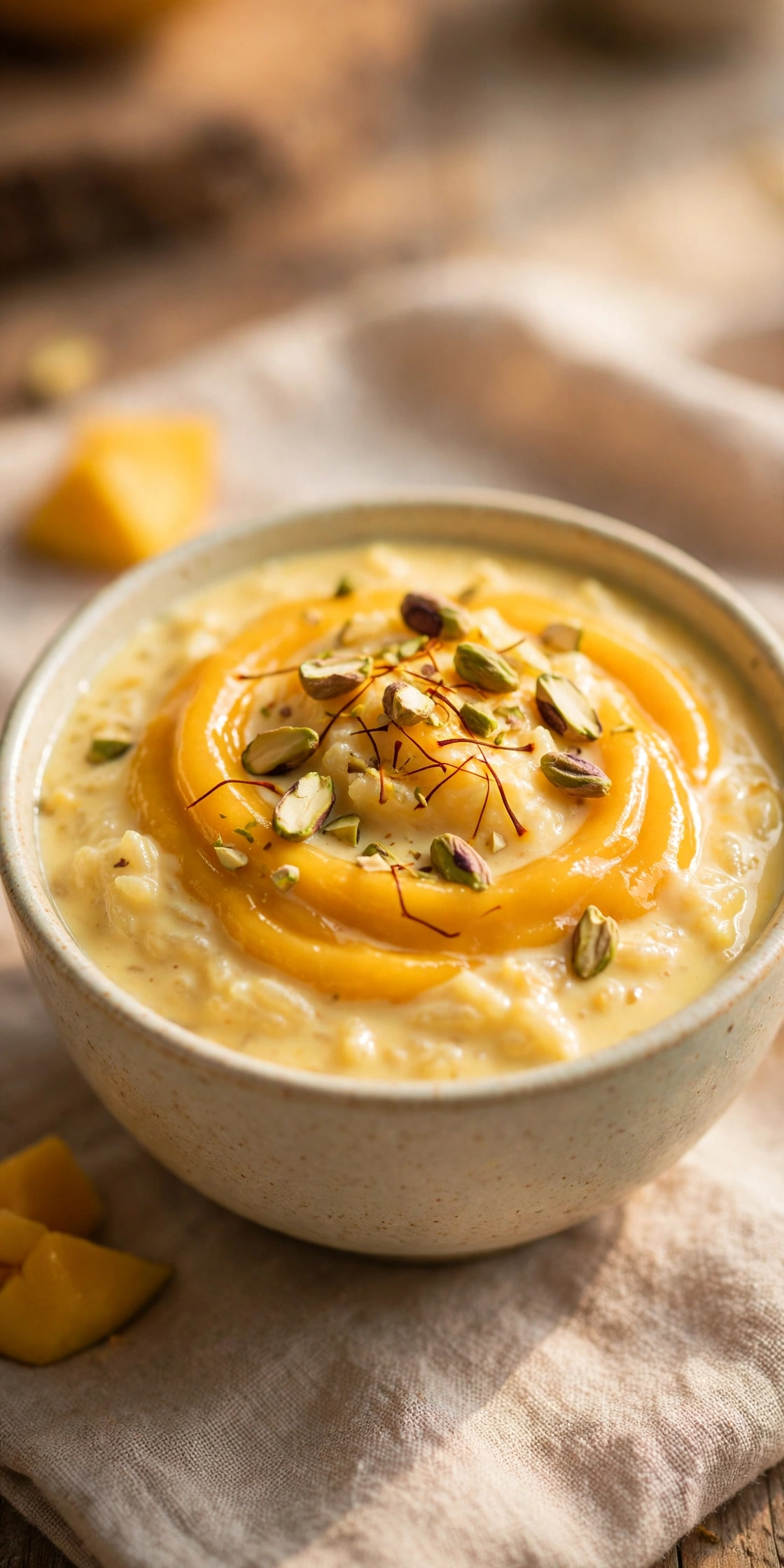
There is a kind of dessert that does not need to impress anyone to be loved. Mango kheer is that kind of dessert. It is cool, creamy, and gently sweet, with the fragrance of mango running through every spoonful. It is the dessert you make ahead, chill in the fridge, and bring out when guests are already full but still ask, just one small bowl, please.
Kheer is rice simmered slowly in milk until the grains soften and the milk thickens. Mango kheer folds mango pulp in at the end, so the fruit stays bright. Cardamom adds warmth, pistachios add crunch, and saffron, if used, gives a golden glow.
This is also forgiving: no oven or mixer needed, just a heavy pot, patience while the milk simmers, and time to chill. It is ready before dinner starts, ideal for summer or a festival table.
Why Mango Kheer Works So Well
Good kheer coats a spoon and pours slowly, with rice grains soft but distinct. That texture comes from simmering: rice releases starch into the milk as it reduces gently, until the pot turns silky.
Mango pulp is added off the heat, because long boiling fades its fresh flavor. Stirring it in after cooling keeps it tasting like mango and keeps a soft, sunny yellow color.
Chilling finishes the work: kheer thickens as it cools and flavors settle, so it tastes even better after two hours in the fridge. Finish it in the morning and forget it until serving.
What You Need
Basmati rice is the classic choice, and a small amount goes a long way. A quarter cup of rice is enough for six servings, because the grains swell and thicken the milk as they cook. Rinse the rice well and soak it for twenty minutes if you have time. Soaking is not required, but it helps the rice cook evenly and shortens the simmer a little.
Whole milk gives the richest result. Reduced-fat milk works but will be thinner, so simmer longer. Sweetened condensed milk adds sweetness and body, but if you use it, reduce the sugar.
For mango, use canned mango pulp or fresh ripe mangoes, whichever you have. Canned Alphonso pulp is reliable and tastes consistent, which is why many cooks prefer it for kheer. If you use fresh mangoes, choose very ripe, sweet ones, and puree the flesh until smooth. Avoid fibrous or sour mangoes, because they will make the kheer taste sharp instead of sweet.
Cardamom, saffron, and pistachios finish it. Freshly ground cardamom is best, saffron soaked in warm milk adds color, and pistachios give crunch and contrast.
How to Make Mango Kheer
Rinse and soak the rice, then add it to a heavy pot with whole milk. Bring the milk to a gentle simmer over medium heat, stirring often so the rice does not stick to the bottom. Once it simmers, lower the heat and cook slowly for thirty to forty minutes, stirring every few minutes. The rice should be very soft, and the milk should look creamy and reduced.
Stir in sugar and cardamom, and cook for five more minutes until the sugar dissolves. If you are using saffron, stir in the saffron milk now. Remove the pot from the heat and let the kheer cool for twenty to thirty minutes, stirring now and then so a skin does not form on top.
When the kheer is warm, not hot, stir in the mango pulp. Mix well until the color is even. Taste and adjust the sweetness, because mangoes vary. Pour into a serving bowl or individual bowls, cover, and chill for at least two hours. Serve cold, topped with pistachios and a few saffron strands if you like.
Recipe Card: Mango Kheer
Prep time: 10 minutes. Cook time: 40 minutes. Chill time: 2 hours. Total time: 2 hours 50 minutes. Servings: 6 servings.
Ingredients
- 1/4 cup basmati rice, rinsed and soaked 20 minutes, drained
- 4 cups whole milk
- 1/3 cup sugar, plus more to taste
- 1/2 teaspoon ground cardamom
- 1 pinch saffron soaked in 2 tablespoons warm milk, optional
- 1 cup mango pulp (canned Alphonso pulp or fresh ripe mango puree)
- 2 tablespoons chopped pistachios, for topping
- A few saffron strands, for topping, optional
Instructions
- Rinse the basmati rice well, soak for 20 minutes, and drain.
- Add the rice and whole milk to a heavy-bottomed pot. Bring to a gentle simmer over medium heat, stirring often.
- Reduce heat to low and simmer for 30 to 40 minutes, stirring every few minutes, until the rice is very soft and the milk is creamy and reduced.
- Stir in sugar and cardamom. Cook for 5 more minutes until the sugar dissolves. Stir in saffron milk if using.
- Remove from heat and cool for 20 to 30 minutes, stirring now and then to prevent a skin from forming.
- When the kheer is warm, not hot, stir in the mango pulp until the color is even. Taste and adjust sweetness.
- Pour into a serving bowl or individual bowls, cover, and chill for at least 2 hours.
- Serve cold, topped with chopped pistachios and saffron strands if using.
Tips for the Best Kheer
Use a heavy pot on low heat, because milk scorches easily. Stir often, especially in the last ten minutes, so rice does not stick and the kheer thickens evenly.
Do not add mango pulp while kheer is boiling hot, which dulls mango flavor. Warm is right: if the pot side feels comfortable to touch for a few seconds, it is cool enough.
Taste before chilling, not after. Mangoes vary a lot in sweetness, and cold food tastes less sweet than warm food. A kheer that tastes just sweet enough while warm may taste a little flat when cold, so make it a touch sweeter than you think it needs, then chill and serve.
Variations to Try
For a coconut mango kheer, replace one cup of the whole milk with full-fat coconut milk. The result is a little richer and more tropical, and it pairs well with toasted coconut on top. Keep the simmer gentle, because coconut milk can separate if it boils hard.
For a rose and pistachio version, add a few drops of rose water with the mango pulp and top generously with pistachios. The rose flavor should be gentle, not perfumed, so add a little at a time and taste. This version is especially pretty for a celebration table.
Make-Ahead and Storage
Mango kheer is made for making ahead. Prepare it a day in advance, cover tightly, and refrigerate for up to 3 days. Stir well before serving, because the rice settles a little as it chills. If it thickens more than you like, stir in a splash of cold milk until it pours slowly again.
Do not freeze mango kheer. Freezing changes the texture of both the rice and the mango, and the kheer can turn grainy when thawed. It keeps well in the fridge, so a small batch made fresh is always better than a frozen one.
Frequently Asked Questions
Can I use fresh mangoes instead of canned pulp?
Yes. Use very ripe, sweet mangoes, and puree the flesh until completely smooth. You need about one cup of puree. Taste the puree first. If it is sour or fibrous, canned Alphonso pulp will give a smoother, sweeter result.
Why is my kheer too thin?
Kheer thickens a lot as it cools, so judge it after chilling, not while it is hot. If it is still thin after two hours in the fridge, it likely needed a longer simmer. Next time, cook five to ten minutes longer, stirring often, until the milk looks creamy before you add the mango.
Can I make kheer with reduced-fat milk?
You can, but it will be thinner and less creamy. Simmer a little longer to reduce the milk further, and consider adding two tablespoons of sweetened condensed milk for body. Whole milk gives the best texture for this recipe.
How long does mango kheer last in the fridge?
It keeps well for up to 3 days in a covered container. Stir before serving and add a splash of cold milk if it has thickened too much. Serve it cold, straight from the fridge, for the best flavor and texture.
Is mango kheer gluten-free?
Yes, as made here it is naturally gluten-free. Rice, milk, mango, sugar, cardamom, saffron, and pistachios contain no gluten. If you serve it with anything else, check those items separately, but the kheer itself is safe on that point.
Mango kheer is proof that a dessert does not need to be complicated to feel special. With slow-simmered rice, sweet mango, and a cold, creamy spoonful, you have a dessert that is ready before dinner, and gone long before anyone asks for the recipe twice.